Sunday, May 06, 2012

Big Game, Big Gap

Most of you will be surprised at the stance this animal rights activist takes. She's mad about ranches in Texas that raise big game animals that are endangered or extinct in the wild. The ranches allow 10% of their animals to be hunted for sport. The money from the hunt supports the large ranches and growing populations. Even so, she think this is wrong. Here is some of the transcript from 60 Minutes starting at about the 6:40 mark.
Priscilla Feral is president of Friends of Animals, an international animal rights organization. For the past seven years, she's been fighting in court to stop these rare African antelope from being hunted in Texas. 
Feral: They're breeding these antelopes, they're selling the antelopes, and they're killing the antelopes. And they're calling it conserving them. They are saying it's an act of conservation and that's lunacy. 
Logan: You would rather they did not exist in Texas at all? 
Feral: I don't want to see them on hunting ranches. I don't want to see them dismembered. I don't want to see their value in body parts. I think it's obscene. I don't think you create a life to shoot it. 
Logan: So, if the animals exist only to be hunted... 
Feral: Right... 
Logan: ...you would rather they not exist at all? 
Feral: Not in Texas, no.
Wow. Later in the piece we hear a little more from her.
But for Priscilla Feral, the bottom line is that these animals should not be hunted. She's helped create a reserve in Senegal for 175 orxy and in court, she's winning the legal battle she's been fighting for years to stop them from being hunted in the U.S. 
... 
Feral: The future for oryxes is Africa. It's not Texas. 
Logan: Can the future not be both? Don't they have a greater chance of survival the more of them there are?
Feral: In their native lands. 
Logan: Regardless of where they are? 
Feral: I don't think you can say regardless of where they are. A Texas hunting ranch is not the same as being in a reserve in Senegal. 
Here we have her saying to the incredulous reporter, that if these animals can't exist in Senegal, then they shouldn't exist at all.

Switching gears, this argument reminds me a lot about the line of reasoning used when we talk about income inequality. Some people would rather that we all be equally poor rather than have some people who are rich, even if having rich people means that the poor will be better off than they would be otherwise. Since some people find the disparity in wealth inherently evil--just like Feral think that hunting these animals is inherently evil--they can't make a compromise with people who believe the gap is an acceptable cost for the increased benefits to all.

Do you think income gaps are sufficiently evil that we should abolish them, even if that means less prosperity for everyone?

Friday, February 11, 2011

SB 124, or Stupid Bill 124

I called my state senator Friday to complain about SB124, a bill that makes it a separate, misdemeanor crime to leave your (under 9 years old) child(ren) alone in a car. I am SO annoyed by this bill, and with the Utah State Legislature in general this session. (I'll let you know if I hear back from him.)

First, the specifics: This bill is STUPID. Already the police have permission to intervene when children are left in a dangerous situation--alone in a car while Mom shops for 20 minutes, alone in a car in the cold cold winter or hot hot summer--it's called child endangerment. If the police officer thinks it is a dangerous situation, he or she has the ability to take care of it.

But--if this law passes--it will now be illegal to leave Hebs in the car while I go back in the house to get Gee and Mimi. Illegal to leave the littles in the car while I step 30 feet away to fetch Zee or Em from school. Illegal to get everyone in their carseats, fastened safely, and realize I left my purse--with the car keys--in the house.

I am frustrated enough with the restrictions society places on parents already, especially parents with big families. I'm already annoyed with the Legislature for another bill they are trying to pass, about making league sports have doctors on call or on the sidelines for concussions. For the record, I'm all for doctor support for sports concussions, I just think the State shouldn't be regulating it.

"But it's for the children!" they shout. To quote Colonel Potter, "Horsepucky!" It's about a nanny state, legislating for the sake of legislating, and, in the process, making us criminals by simply going about our lives.

And I'm sick of it.

Sunday, January 23, 2011

Prohibition on Drugs

I have very conflicted emotions about the prohibition on certain drugs. Part of me wants to insist that we should prohibit destructive behaviors. I don't believe that illegal drug use is a "victimless crime" and I don't think we should embark on self-medicating journeys without someone experienced to guide us.

Drugs have been a blessing in my life. I can't imagine getting dental work done without the help of the pain relievers and numbing agents the dentist can use. But there is a class of drugs that have proven mostly dangerous. As a society, we've decided to make them illegal. We don't want to deal with the fallout of people taking these drugs.

My church is supportive of the ban on these drugs. That holds a lot of weight for me.

Yet I wonder if the prohibition is causing more problems than it is preventing. John McWhorter writes over at The New Republic that the easy "occupation" of selling drugs has enticed many young black men to forgo productive employment and opt for life on the street. He argues that this is one of the core problems plaguing the black urban community. Have a sample.
The end of the War on Drugs is, in fact, what all people genuinely concerned with black uplift should be focused on.... The black malaise in the U.S. is currently like a card house; the Drug War is a single card which, if pulled out, would collapse the whole thing.

That is neither an exaggeration nor an oversimplification. It comes down to this: If there were no way to sell drugs on the street at a markup, then young black men who drift into this route would instead have to get legal work. They would. Those insisting that they would not have about as much faith in human persistence and ingenuity as those who thought women past their five-year welfare cap would wind up freezing on sidewalk grates.
There would be a new black community in which all able-bodied men had legal work even in less well-off communitiesi.e. what even poor black America was like before the '70s; this is no fantasy. Those who say that this could only happen with low-skill factory jobs available a bus ride away from all black neighborhoods would be, again, wrong. That explanation for black poverty is full of holes. Too many people of all colors of modest education manage to get by without taking a time machine to the 1940s, and after the War on Drugs black men would be no exception.

Tuesday, November 02, 2010

Election Day

(Now with updates in red!)

It's Election Day, and you know what that means...

...another long political post from Keryn that you can ignore. Yay!

So...the Senate races are some of the biggest to watch. In particular, I'll be looking at:
  • Nevada (duh): Angle (R) vs Reid (D). This one is going to be a squeaker. I'd like to think Angle wins, but I don't know. We'll just have to see. (Reid wins. Bummer.)
  • California: Fiorina (R) vs Boxer (D). I think this one stays with Boxer, although I'll be pleasantly surprised if it doesn't. Boxer comes across as a somewhat obnoxious, and occasionally entitled incumbent; it would be a pleasure if she didn't get sent back to Washington. (Boxer wins.)
  • Colorado: Buck (R) vs Bennet (D). I don't know too much about this one, but it is a toss-up, apparently.
  • Alaska: Miller (R) vs McAdams (D) vs Murkowski (Entitled). This one is interesting. Murkowski is the incumbent, but she lost the primary nomination to Miller. She then decided to run a write-in campaign, essentially becoming a pretty sore loser about the primary. (I have Opinions about this.) The Alaska Board of Elections, on Thursday, decided to change its rules to allow lists of write-in candidates' names in the polling places, giving Murkowski a distinct advantage. There have been some very sleazy events surrounding this election. However, polling looks good, and it's hopeful that Miller will win. We'll see!
  • Washington, Pennsylvania (goes to Republican, thankyouverymuch Arlen Specter R-2, D-2), West Virginia (stays Democratic), and Illinois (President Obama's old seat has gone Republican!) are good ones to watch, as well.
The House is likely to switch parties today (the Senate less likely, but there is a wee little chance), and the number to watch for is 39--the Republican party needs a net gain of 39 to reach the 218 votes needed to have control of the House. (Major news networks are calling the House for the Republicans. No big surprise there.) I haven't been too interested in too many of these races, but an interesting one to follow will be Nevada: Congressional District 3 (suburban Las Vegas, but I don't know if that includes my family's home) Heck (R) vs Titus (D). This one wasn't supposed to be a close race, but Heck has been polling closer and closer to Titus in the last weeks. (And that would be just cool, because then two of Nevada's representatives would be named "Heller" and "Heck".)

Also, keep an eye on Massachusetts' Barney Frank, who might not win reelection. Heh heh. (Bummer. He wins.)

Also, there are some governor's races to watch.
  • Colorado: Hickenlooper (D) vs Tancredo (Annoying) vs Maes (R). I have Opinions about this race as well. Specifically, I think that if the primary voters choose a particular nominee (Maes), then the state GOP should darn well better get behind him and support him. If they can't support the people's choice for nominee, then they should RESIGN their positions in the state party. In this case, that didn't happen. And now Maes has single digit support, and the race is between Hickenlooper and Tancredo. Basically, I'm hoping for Hickenlooper, but since I don't live there, I don't know what that would mean for day-to-day stuff. Still, I'm highly annoyed at Tancredo and the CO state GOP. (Hickenlooper wins.)
  • California: Whitman (R) vs Brown (D). Brown was governor of California from 1975 to 1983, so he knows what's what. Whitman is a multi-killjionaire CEO. This will be interesting. I don't know why anyone would want to be in charge of the mess that is California right now, but different people have different tastes. (Brown wins the...honor?)
Okay, that's my two bits. There are precious few things to care about in my state today, so I'm ranging far abroad for interesting stuff. Even though I voted for Anderson for county commission, I don't care if Henderson wins instead. Ditto for everything else that might be a tight race here. Oh, and I guess I don't want the Constitutional Amendment A to pass. Whoop-de-do.

What do you all think?

Thursday, August 05, 2010

Stupid, Racially Charged Headline


My head is going to explode over this headline: "911 call on Conn. shooting shows racial disparity". I don't know who wrote the headline (Yahoo! or the AP), but it is completely misleading and racially charged.

The first two paragraphs are the only one that deals with the 911 call:
A woman hiding under her desk tells an emergency dispatcher that a co-worker is in the midst of a shooting spree. The dispatcher presses for any information about the man.

"I don't know anything," the woman says, according to a 911 tape released Wednesday. "He's a tall black guy. He's like the only black guy that works here."

How in the WORLD is describing the crazy mad shooter "racially disparity"? That has to be the dumbest, most inflammatory way to describe the caller's actions I can think of. Really, really bad form, AP and/or Yahoo! Super lame.

(The story then goes on to describe the difficulties the man had being the only black man in his office. I have no information about whether or not he was discriminated against in his job. That, however, is not relevant to the headline. The woman under the desk was describing the physical attributes of the attacker for the dispatcher, presumably so the police could identify him.)

Friday, July 23, 2010

Think Progress vs. Breitbart

I've watched from a distance as the flap over Shirley Sherrod has come and gone over the past week. First, Andrew Breitbart posted a video clip that showed her confessing racist feelings. The audience in the video seemed to chuckle at the sentiment rather than act repulsed or disappointed.

The USDA immediately believed the worst about Sherrod and forced her to resign before they even had a conversation with her to understand her side of the story.

Shortly, the larger picture came out. Sherrod was confessing that she had been a racist but was trying to tell a story of how she moved past those feelings. The clip had been unfair to her. As the news was breaking, my wife was scanning the blogs as we were driving. She started rattling off the list of people who retracted their denouncements of Sherrod. Glenn Beck, Rich Lowry, Shannon Coffin, Jonah Goldberg... basically all the big conservative bloggers immediately set the record straight.

It was really encouraging. Someone made the point, in defense of Breitbart, that it is possible to act rashly without acting maliciously. Breitbart claimed to have received only the small clip that he played and that he hadn't checked the larger context before he posted.

This morning, I was reading through some older posts and I came across a link to a video created by Think Progress.  My jaw dropped to the floor. They were splicing together clips from Tea Party activists making racist comments. This may be one of the most dishonest political clips I've ever seen.

The editors at Think Progress chose to use a video clip statement from a man being actively expelled from a Tea Party event as representative of the content of the event. Breathtakingly dishonest. It is like using ellipses to turn a negative movie review into a positive one.

Here is the Big Government post that criticizes the Think Progress clip.

Will Chris Matthews and Keith Olberman now denounce Think Progress as they did Andrew Breitbart? Will those on the left who were fooled by the video come out and apologize as so many on the right have done? This is a test of character. Let's see how it goes.

Monday, June 21, 2010

Pox: Lee AND Bridgewater

I'm so fed up with Mike Lee and Tim Bridgewater, I've decided that I won't cast a vote for either of them tomorrow. There are two reasons for this.

First and most important, they are both running negative campaigns and it is disgusting me. On a small flyer I got from Mike Lee, 25% percent of the space was consumed by stuff he didn't like about his opponent. The rest was filled with photos and fluff.

Bridgewater had the gall to send me a campaign flyer in the mail that denounced Mike Lee for running a negative campaign--and then attempted to smear him for being a lawyer. A short time later, the next flyer in the mail comes from Bridgewater attacking Lee for carrying water for EnergySolutions.

Way to lead by example about how you'll improve the tone in Washington.

The second reason I won't vote for either of them is the blatant disregard they've shown to having my telephone number. The other night, we returned home after a day of being gone. In the two and a half hours, we received SEVEN robocalls from the two candidates. It was infuriating that they would disrespect my time like that. Today, one day before the primary, we've counted 16 calls so far today. Two of them were real people, the rest were robocalls.

Here is a tip to future candidates. (I'm sure they'll all be reading this blog post intently.) As a voter I love to be informed. I appreciate getting a call or two with information about candidates or an endorsement. Especially calls from real people. But if you are wasting your money calling the same people with the same message over and over, I don't trust you to spend money wisely while you're in office.

Friday, June 04, 2010

Glenn's Favorite Graphic

Glenn Reynolds (Instapundit) used to put up this graphic pretty frequently. It is the one I think of when people complain about the Tea Party protests being overly partisan.

I'd be curious to see the current numbers for '09 now that that is in the books. Perhaps we'll start seeing an updated view of the spending that will either confirm or refute this rather stunning chart.

Thursday, June 03, 2010

Why My Sister Couldn't Be a Union Boss

My sister is a leader of her local Tea Party movement. The folks in her area have decided they want to get together every two weeks. They invite candidates in to address them.

A lot of these people are really angry. They are taking the time to not only "vent" but to get informed. That is cool. Even so, some of the participants will ask my sister who she is endorsing or recommending in the various elections.

In the face of these requests, it would be easy to counsel these people how to vote. However, my sister doesn't feel comfortable making these calls. She wants people to choose for themselves. She sees her role as being a facillitator of information dissemination.

Think how cool it would be if politically active unions and other organizations would showthe same respect to their diverse members.


Wednesday, March 17, 2010

A Great Moment of Political Drama

Basking in the coolness of the new C-SPAN Video Library, I watched some of the Clinton impeachment hearings and came across a striking moment of political drama that I had totally forgotten about.

The two sides in the debate were having their turns giving members one minute speeches either in favor of, or opposed to impeaching the president. The first speech was pro-impeachment and laid out a pretty rational case. The second speech was anti-impeachment and was a massive non sequitor where the congresswoman rambled on about abortion and Medicare and everything except the charges against the president.

The back and forth continued for a couple more speakers. Then, the Republicans bring up their next speaker, Bob Livingstone. However, instead of getting recognized for one minute, he is recognized for two minutes. When he walks up to the podium, he turns to the chair and says something I couldn't hear. (Usually, it is the asking for unanimous consent to revise and extend their remarks in the official record.)

As he started speaking, I didn't remember who he was. Then I realized that he was the Speaker of the House-Elect, set to assume those responsibilities in a few weeks time. He spoke at length, way more than two minutes, laying out the case for impeachment. He builds up to a climax where he tells the president that he can end all this agony right now. A hiss emits from the Democrats in the chamber. Livingston presses forward. He calls on the president to resign.

Immediately, the Democrats start shouting, "No! No! No!" and then the dominant voices in the chorus of dissent are shouting, "You resign! You resign!" You see, Livingston had recent admitted to his own extra-marital affair and the Democrats thought it was high hypocrisy (if not a high crime and misdemeanor) for one philanderer to call for the resignation of another philanderer.

After a moment, the chamber quieted enough for Livingston to continue. He seemed to steel himself for the moments to come. And then he announced that he had been unfaithful to his wife and that he would lead by example. He would not take a role as the Speaker of the House, and he would resign his seat in 6 months time when there could be a special election to replace him. He then called on the president to follow his example and resign.

The whole chamber erupted in applause. It looks like even the Democrats gave him a standing ovation. Probably different motives for the applause on the two sides of the aisle, but still an impressive display. It must have been somewhat unexpected for him to make the move and the chamber was all abuzz and the next speaker had a hard time getting started again.

What an interesting moment of political drama, and a moment of political courage as well. I wish more politicians had the courage to admit failure and step aside when appropriate. Instead, many of them cling to power and frequently, though inexplicably, retain enough votes to stay in place.

If you want to watch the video, you can find it here at about 18 minutes in.

Tuesday, February 09, 2010

HB 113: Child Restraint Device Amendments

I sent this letter to both my state senator and my state congressman. I'll be sure to update the blog with any information they send me.

____________________________

Dear Representative Morley and Senator Madsen,

I have noticed with interest HB113, “Child Restraint Device Amendments”. I believe that the current child restraint device laws are too restrictive, and I am pleased the legislature is considering amending them.

In the book “SuperFreakonomics” by Steven D. Levitt and Stephen J. Dubner, the authors discuss a study indicating that perfectly installed and fitted car seats for 3- and 6-year-olds are no more effective in a crash in protecting children than the poorly fitting built-in seat belt. (A brief summary of their findings can be found here and here at the Freakonomics Blog at the New York Times website.) While I am not claiming that this is a definitive study on the subject, I am interested in learning what studies and reports the Utah State Legislature is using while considering amending the law. I am especially interested in any recent studies about older children (ages 5-8) and booster seats being considered during the deliberative process.

As much as I applaud the direction of the amending (loosening the requirements on older children), I have serious concerns about the language of the amendment. As written, I do not see how this law could be enforced. How would a police officer know if I was driving directly to or from my home? That I was driving to the school or an authorized activity? That I don’t have a booster seat in the trunk in case I have to drive 5 miles away from the house?

As a parent of four children under the age of seven (with a fifth child on the way), I am directly affected by these laws, and will be for a good many years to come. I would very much appreciate hearing from you on your opinion as to these amendments, on how the law would be enforced, and what scientific studies are being used to inform the Legislature on this subject.

Thank you for your service and your help in this request.

Monday, December 28, 2009

Toddler Car Seats Debunked

Shocking result reported in the book SuperFreakonomics. Perfectly installed and fitted car seats for 3 and 6 year olds are no more effective in a crash in protecting children than the poorly fitting built-in lap belt. Hear the authors talk about it in segment 7 of this talk.

Other interesting comments from that segment, though I don't know if all of these are actually backed up by the research or if they are merely conclusions based on the new intuition informed by the study:
  • The passenger seat is the least safe seat in the car.
  • A child would fare better than an adult in the front seat because they are smaller and less likely to get squashed by something.
  • The safest place for an infant would be on the floor of the backseat.
  • Crash testing companies had never done comparative testing of regular seat belts and child seats. The authors were turned down several times. The engineer who finally did the test was certain they were going to destroy his crash test dummy and made them promise to replace it if it got destroyed in the tests using only a plain seat belt.
  • Using a seat belt of any sort makes an enormous difference in the survivability of a crash.
  • Babe-in-arms in the front seat is the worst possible place for an infant.
  • The authors note that other people disagree with their conclusions.
Legislators, will you take action to further investigate this and remedy the situation if further study bears this out?

I feel more oppressed by child safety seat regulation than any other government regulation I can think of because it affects me nearly every day as a father of four children under the age of 7. We switched to a minivan from a sedan when our third child was born because fitting three car seats in the back seat was problematic. (It was hard to close the back doors.)

Now that we have a minivan, I'm still concerned about adding the fifth child to this car because I'm not sure how easy it will be to access the built in seat belt when three booster seats or child seats are squeezed onto that back bench. Perversely, the cumbersome nature of child safety seats makes me less inclined to buckle my kids for trips of three blocks or less. I'm sure that isn't the safety result the legislators were hoping for.

Saturday, December 26, 2009

Thoughts on Humanitarian Aid

Rick Steves, the famous travel guide author, gave a speech to the Commonwealth Club. At the very end of his recorded speech, he riffed for a minute about the differences in European and American approaches to helping the poor and about the obligation that we have to reach out.

You see beautiful kids in your travels that are every bit as precious as our kids. And when I look at these girls on a garbage dump in El Salvador, I see every bit as much deserving beauty there as my own daughter.

I know my daughter's got $5000 for straight teeth and money left over for whitener. And I looked around her class and apparently every girl has $5000 for straight teeth and money left over for whitener. That's not a bad thing. I don't apologize for that. We have a winning society. I work hard; my daughter gets straight teeth.

But that doesn't negate the fact that in this village, the moms are not home because they're out walking for water. And for the cost of two sets of braces, we could drill a well in that thirsty community to parents could stay home and take care of their kids. That's not a guilt trip. That's an opportunity.

I share Rick's desire to improve the world. I also recently heard a bit of wisdom from Sharon Eubank on this topic in a recent lecture at the BYU Kennedy Center. Sharon shared some of her experiences in dealing with international humanitarian aid. Her talk was explicitly about the vital importance of keeping LDS humanitarian aid and LDS proselyting strictly separate to ensure our continued ability to do humanitarian work. I want to highlight a different point from her talk, however.

Sharon is involved in the wheelchair distribution effort for the LDS Humanitarian Services division. For a while, they would find the cheapest wheelchairs to distribute to poor people around the world. This gave them the largest number of wheelchairs for their limited humanitarian dollars. However, they discovered that when the wheelchairs inevitably broke down, there were no local resources to repair or replace the chairs and the recipients were eventually just as bad off as they'd been before. Lesson: Pay more to purchase chairs locally and strengthen the local market to ensure that the chairs and suppliers will have longevity.

Sharon has seen humanitarian projects with big plaques on the wall (see her talk about that about 34 minutes into the video) that stroke the ego of the donor who made it possible. But something perverse happens. The community doesn't feel ownership of the well that was dug or the clinic that was built. Eventually, it decays, along with the sign, and the donor's name emblazoned on the plaque becomes a symbol of neglect and abandonment rather than a symbol of hope and empowerment. Lesson: emphasize community ownership and maintenance. The local people must learn to build and maintain the project and have the resources to carry it forward.

Monday, November 30, 2009

Will Reason Fail?

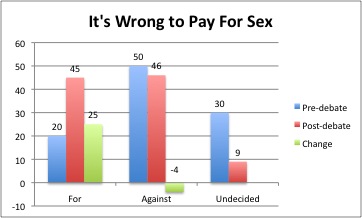
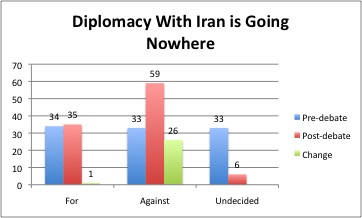
After a debate, which argument is more persuasive? Will conservative viewpoints convince more people, or will liberal viewpoints win the day?

I've been listening to the Intelligence Squared US debates. "Oxford style debate on America's shores." By the rules of the game, the winner is declared based on how many people switched rather than just the predisposition of the crowd that purchased tickets. Given that the events are hosted in New York, it comes as no surprise to me that the liberal point of view on each question usual starts and finishes with a greater majority of the vote. But which point of view causes more people to change their opinion?

The following charts summarize the results of the debates currently available online that had a political angle. (I skipped the debates that didn't seem to highlight a left/right divide such as "Good Riddance to the Mainstream Media" and "The Art Market is Less Ethical than the Stock Market.") Click the chart to see the date of the debate the the info about the participants.


Is it surprising that you find such a high number of people that pay $35-$45 to attend a debate and leave without picking a side?

Do these results mean that conservatives are more likely to hear the arguments before making a decision? Or does it mean that, after a full hearing of both sides of an issue, people are more likely to agree with conservatives? Do you think people, particularly conservatives, are going in with the intention of misstating their original belief so that their side will garner more "switch" points?

Should we expect more people to be persuaded by arguments? In an "enlightened" society, shouldn't we see a large majority switching to the side with the more "reasonable" arguments? Why don't we see that?

Sunday, October 11, 2009

Thanks for the Memories

How good is your memory? I seem to be blessed with a particularly faulty memory, including a shockingly poor ability to remember if I've seen a face before.

Do you remember the famous Hillary Clinton whopper where she talked about her mortal peril in Bosina? She said, “I remember landing under sniper fire. There was supposed to be some kind of a greeting ceremony at the airport, but instead we just ran with our heads down to get into the vehicles to get to our base.”

Her account is at odds with the facts (we have video), but the question remains, was she lying? We'll never know, but there is a remarkable amount of scientific research demonstrating the malleability of our memories. It is entirely consistent with scientific research to suppose that Hillary actually believed the Bosnia account as she told it.

Elizabeth Loftus used Clinton as an example in a lecture where she recounted lots of other juicy info about memory. Here are some tidbits:
  • There is no evidence for "repressed memories" as popularly understood.
  • Researchers have been able to "encourage" people to remember childhood incidents like getting lost in the mall or getting sick after eating an egg salad sandwich--that never happened.
  • People can convincingly recount their memories of seeing Bugs Bunny at Disneyland, after reading a key piece of bogus advertising as a seed for the impossible memory. (They don't have Bugs at Disneyland, as you probably know.)
  • That false memory of the egg salad sandwich made those who were susceptible to the memory less likely to eat egg salad sandwiches up to four months later.
  • False positive memories about asparagus made people more likely to claim they would order asparagus at a fancy restaurant.
Isn't it crazy how changeable our memories are? I recounted the following information to a colleague. A few days later she included the material in a training exercise and got all the numbers wrong. Apparently, our memories about memory research is also susceptible to corruption. (Hence this post.) Ginger Campbell is summarizing the research presented in the book "On Being Certain" by Robert Burton. Here is an excerpt that will probably surprise you. Emphasis mine.

So within a day of the Challenger explosion he interviewed 106 students and he had them write down exactly how they heard about it, where they were, what they were doing, and how they felt. Two and a half years later, he interviewed them again and he found that for 25% of them their second account was significantly different from their original journal entries. In fact, more than half the people had some degree of error and less than 10% gave all the details exactly the same as they had originally.

Even so, before they saw their original journals, most of them were certain that their memories were absolutely correct. In fact many of them, when confronted with what they had originally wrote down, still had a high degree of confidence in their false recollections- even when faced with journals in their own handwriting, because they just felt that their current memories were correct. In fact, there was one student who said, "That's my handwriting but that's not what happened."
The moral of this story? Give people the benefit of the doubt and trust their sincerity until you have solid reason to believe otherwise. Thanks for the lesson, Secretary Clinton.